Showing posts with label Black female. Show all posts
Showing posts with label Black female. Show all posts
Wednesday, October 26, 2011
Friday, September 23, 2011
Celebrity Friday: First African Miss Universe Fights HIV
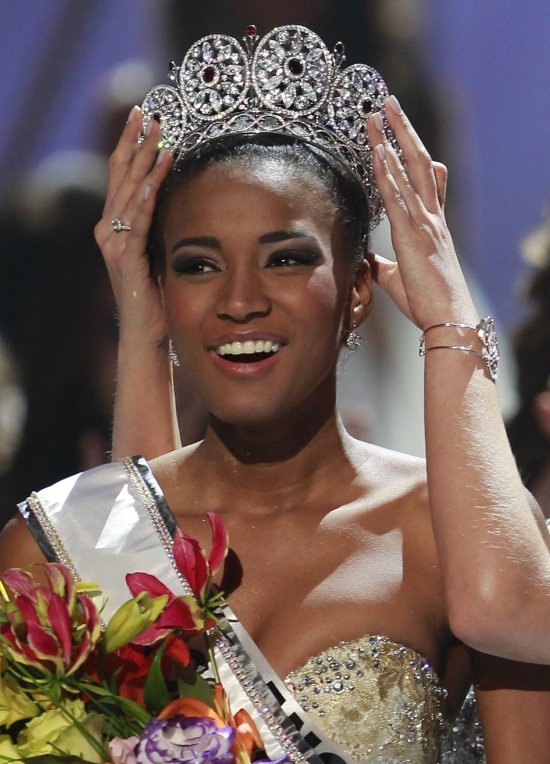 |
| Leila Luliana da Costa Vieira Lopes, Miss Angola, was crowned Miss Universe |
Nigeria's Vanguard newspaper reports:
This is the first time a beauty queen from Angola has been crowned as Miss Universe. She is first black African to win the 60 year-old pageantry. Nigeria’s Agbani Darego won the 51st Miss World pageant in Sun City, South Africa, on 17 November, 2001.
[...]The brand new Miss Universe, Leila Lopes said she wants to help her native Angola escape a history of war and impoverishment and work towards combating HIV.Being crowned at the ceremony in Sao Paulo, Brazil, the 25-year-old said that “as Miss Angola, I’ve already done a lot to help my people.”“I’ve worked with various social causes. I work with poor kids, I work in the fight against HIV. I work to protect the elderly and I have to do everything that my country needs,” she said. “I think now as Miss Universe I will be able to do much more.”

Monday, September 12, 2011
US OPEN 2011: Playing Tennis While Black? #PTWB
Let's go to the text shall we?
So the ruling by the umpire was the Serena deliberately hindered Stosur by screaming "come on." This is absolute bovine excrement and must be reported as such. Why is it deliberate hindrance to scream out "come on!" before an opponent hits an unreturnable ball? If the ball WAS returnable, then I think one could rule it was a deliberate hindrance. Because, the player was deliberately hindered from returning it into play. But the ball was not playable so regardless of what Serena said or did that ball was not coming back into play. The bigger question is, why did the same umpire rule differently at the US Open than two years ago at the Doha 2009 tournament, under essentially the same rules in an identical situation? That umpire, Eva Asderaki like the notorious Marina Alves, should never be allowed to referee a Serena Williams match again.
But the bigger issue is with the ability of umpires and officials to make calls which videotape allows the fans and observers to know are incorrect. That is what used to happen with line call and now (thanks to the 2004 U.S. Open quarterfinals match with Jennifer Capriati and Serena Williams when repeated, obvious line calls were made against Serena by Referee Marina Alves) we have electronic line calling. And tennis is much better for it. Ask Maria Kirilenko!
The ITF rules on "hindrance" state (Rule 26):
"If a player is hindered in playing the point by a deliberate act of the opponent(s), the player shall win the point. However, the point shall be replayed if a player is hindered in playing the point by either an unintentional act of the opponent(s), or something outside the player’s own control (not including a permanent fixture).”
The WTA rules (pdf) on "hindrance" state:
If a player hinders her opponent, it can be ruled as either involuntary or deliberate.
1. Involuntary Hindrance
A let should be called the first time a player has created an involuntaryhindrance (e.g., ball falling out of pocket, hat falling off, etc.), and the player should be told that any such hindrance thereafter will be ruled deliberate.
2. Deliberate Hindrance
Any hindrance caused by a player that is ruled deliberate will result inthe loss of a point.My issue is with the interpretation of the rule. In what way did Serena's scream hinder Stosur in returning the ball? How do Azarenka's and Sharapova's shrieks not hinder the player on the other side of the net? If grunting is not involuntary hindrance than neither should screaming "come on!" If one takes the position that screaming out a word right before one's opponent is going to hit the ball is involuntary hindrance then a let should be played. It was very clear that Serena had hit a winner and was screaming out "come on!" as almost all tennis players do at that point. No human in that position was going to get that ball back in the court. Stosur happened to get her racquet on the ball before it bounced twice but no way was she going to get the ball back into play. If it had been some other event which had interrupted play the umpire should rule that Stosur had no play on the ball and give the point to Serena. But umpires often do interpret the rule (wrongly, in my view) that if the player gets a racquet on the ball (or is even in the vicinity of the ball when the incident happens) then the entire point needs to be replayed.
So the ruling by the umpire was the Serena deliberately hindered Stosur by screaming "come on." This is absolute bovine excrement and must be reported as such. Why is it deliberate hindrance to scream out "come on!" before an opponent hits an unreturnable ball? If the ball WAS returnable, then I think one could rule it was a deliberate hindrance. Because, the player was deliberately hindered from returning it into play. But the ball was not playable so regardless of what Serena said or did that ball was not coming back into play. The bigger question is, why did the same umpire rule differently at the US Open than two years ago at the Doha 2009 tournament, under essentially the same rules in an identical situation? That umpire, Eva Asderaki like the notorious Marina Alves, should never be allowed to referee a Serena Williams match again.
But the bigger issue is with the ability of umpires and officials to make calls which videotape allows the fans and observers to know are incorrect. That is what used to happen with line call and now (thanks to the 2004 U.S. Open quarterfinals match with Jennifer Capriati and Serena Williams when repeated, obvious line calls were made against Serena by Referee Marina Alves) we have electronic line calling. And tennis is much better for it. Ask Maria Kirilenko!
What drives us observant followers, fans and players of the game insane is that there are a LOT of these subjective interpretations of the rules in the game of tennis and more often than not they seemed to be interpreted arbitrarily (or to the detriment of Serena at the U.S. Open). My point is that there should be an increased attempt to REDUCE subjectivity in tennis and have all umpire calls appealable by going to an objective source such as videotape (where available) and then a ruling by the tournament referee using the objective source.
Incidents such as "not up," "foot faults," "non-racquet contact with the ball" are all examples of situations which could be resolved by going to the videotape. You can also find multiple examples where umpires have made questionable (and incorrect) rulings against Serena Williams, Venus Williams and James Blake where the video shows pretty clear that the umpire was in error. What do these players all have in common? Hmmmmm.
There are video cameras in the cars of police officers all around the country to prevent incidents of what is known as "Driving While Black or Brown)."
All players need the ability to review video of incidents on the tennis court to substantiate umpire rulings!
Until that time, anyone playing in an official match, especially if they have "dark" skin may be subject to an incident of "Playing Tennis While Black"!
Wednesday, August 3, 2011
CDC Releases New Data on HIV Infections 2006-2009


A key excerpt from the press release:
Some of the key take-aways from the report are:According to the new estimates, there were 48,600 new HIV infections in the United States in 2006, 56,000 in 2007, 47,800 in 2008 and 48,100 in 2009. The multi-year incidence estimates allow for a reliable examination of trends over time. They reveal no statistically significant change in HIV incidence overall from 2006 to 2009, with an average of 50,000 for the four-year period. In 2009, the largest number of new infections was among white MSM (11,400), followed closely by black MSM (10,800). Hispanic MSM (6,000) and black women (5,400) were also heavily affected.“While we’re encouraged that prevention efforts have helped avoid overall increases in HIV infections in the United States, and have significantly reduced new infections from the peak in the mid-1980s, we have plateaued at an unacceptably high level,” said Kevin Fenton, M.D., director of CDC’s National Center for HIV/AIDS, Viral Hepatitis, STD and TB Prevention. “Without intensified HIV prevention efforts, we are likely to face an era of rising infection rates and higher health care costs for a preventable condition that already affects more than one million people in this country.”
- Overall HIV incidence in the U.S. has been relatively stable, with approximately 50,000 annual new infections
- New infections among young men who have sex with men (MSM) increased 34% between 2006 and 1009
- Young, black MSM (aged 13-29) is the only subpopulation in the U.S. to experience a statistically significant increase from 2006 through 2009
- New HIV infections increased 48% – from 4,400 in 2006 to 6,500 in 2009
- The new data confirm that HIV continues to disproportionately affect MSM of all races/ethnicities
- MSM represent 2% of the total U.S. population, but accounted for 61% all new HIV infections in 2009
- Among MSM in 2009, white MSM represented the greatest number of new HIV infections (11,400), followed closely by black MSM (10,800) and Hispanic MSM (6,000)
Wednesday, June 1, 2011
WATCH: Black Lesbian Couple 1st To Get Illinois Civil Union
Lakeesha Harris and Jeanean Watkins, a Black lesbian couple with a registered domestic partnership, were first in line to get their civil union license when Illinois civil unions law went into effect today, June 1. Governor Pat Quinn signed the bill into law earlier this year. Hawaii and Delaware also enacted civil union laws this year that go into effect later.
Hat/tip to Wonder Man.
Subscribe to:
Comments (Atom)
